
From Insights to Identity: Globist’s Strategic Design
what i did
UX & Brand Strategy Research, Brand Identity, & UI Design
for
Globist AI

context
Globist AI is a visual-first AI research platform designed to transform complex research into a dynamic, intuitive experience. Instead of relying on linear, text-heavy methods, Globist enables users to explore information through interconnected visual-first information, making discovery more fluid and engaging. Its primary audience includes professional researchers seeking new ways to navigate knowledge, with students as a growing secondary user group who value visual and collaborative exploration.
At the stage they approached me, Globist had launched an MVP with promising functionality but could have help with the design maturity and structure. The platform existed, but it wasn’t clear what direction it should take to balance functionality with aesthetic coherence.
The core challenge wasn’t just about refining the product—it was about creating a sense of identity. While the MVP showcased interesting features, there was no clear design system or brand language to tie them together. This gap made it difficult for users to understand what Globist stood for and how they were supposed to engage with it.
My role was to conduct market, competitor, and problem research to help Globist understand where it fit, and to extend those insights into identity and design recommendations. This included shaping their brand identity, validating the direction with research, and ensuring that both the product experience and external-facing collaterals like the landing page and Published Canvas felt cohesive and future-ready.

problem
Globist’s key challenges emerged across both user and business dimensions:
User POV
Researchers found the platform intriguing but not smooth to use, exploration felt experimental rather than reliable.
Students were curious but lacked clear guidance on how to engage with the platform, leaving them uncertain about its value.
Business POV
The lack of a cohesive identity and positioning meant Globist struggled to be recognized as credible in the market.
Messaging was fragmented: the team did not know whether to emphasize being a research tool, an AI-first product, or an exploration platform.
This uncertainty affected external confidence, making it harder to pitch to investors, attract users, and scale effectively.
Together, these gaps meant Globist risked being perceived as immature: too complex for users to adopt with confidence, and too vague in its identity to attract external validation.
goals
The goals of the project were to position Globist not just as another research tool, but as a category-defining platform where curiosity meets structured exploration. To achieve this, the work needed to balance user expectations with business imperatives:
Positioning & Recognition: Craft a brand identity and messaging system that reflected Globist’s mission of making research engaging, transparent, and intuitive—ultimately helping it stand out from competitors and resonate with investors.
User Adoption & Experience: Improve how users perceived the product’s usability and shareability, ensuring that researchers and students felt guided and confident when engaging with visual exploration.
Scalability & Growth Enablement: Extend the identity into critical growth pillars like the landing page and Published Canvas, equipping the team with a credible and consistent foundation for investor pitches, user adoption, and product expansion.
The ultimate aim was to align user needs for smoother, curiosity-driven exploration with business needs for credibility and growth; transforming Globist from an MVP into a recognizable, trusted, and scalable brand.

success criteria
Success for Globist was defined less by strict quantitative benchmarks and more by directional outcomes that would signal the platform was maturing beyond its MVP stage.
The key criteria included:
Recognition & credibility: ensuring Globist looked and felt like a serious research tool rather than a prototype.
User excitement: creating a brand identity and product experience that researchers and students found engaging and shareable.
Clarity of messaging: establishing a consistent, recognizable voice that communicated what Globist stood for.
Smoother usability: improving product flow so that new users experienced less friction and more intuitive discovery.
Usability Feedback Results: measuring usability feedback through a survey to validate whether the brand and experience resonated as intended.
approach
The way this project was approached reflected a balance between research rigor and product strategy, ensuring that exploration was not detached from practical application.
Hybrid mindset: The project was treated as both a research challenge and a brand-building exercise. This meant weighing user needs, business intent, and long-term positioning equally, instead of letting one dominate.
Research-first orientation: Every brand, design and product consideration was grounded in research. Secondary studies, environmental scans, and thematic exploration set the foundation before visual or functional directions were shaped.
Structured yet flexible framing: While the double diamond provided an overarching structure, flexibility was essential to adapt to Globist’s ambiguous early-stage needs. The emphasis was on continuously reframing the problem as new information emerged.
Strategic synthesis: Rather than treating findings as raw data points, the focus was on surfacing themes that could guide product direction and brand identity in tandem.
Stakeholder alignment: Research insights and thematic directions were consistently communicated with the founding team, ensuring decisions were not just evidence-based but also feasible and relevant for their stage of growth.
process
Phase 1: Discovery & Mapping
The project began with aligning expectations directly with Globist’s founder. Since the platform was in its MVP stage, there was very little structure for how the brand should evolve. The challenge wasn’t just visual polish, it was figuring out what Globist should be. My role was to understand the gaps in both product and brand maturity and to chart a path forward.
From a UXR perspective, this meant defining the right research questions: Who exactly is the platform serving? What gaps exist in the product experience? How does Globist fit into the larger ecosystem of AI research tools? From a PM perspective, it meant structuring these broad questions into a phased execution so that both founder and stakeholders could see progress at each stage.
By the end of this phase, we had mapped the current state of Globist—an MVP with promising ideas but needed help in a coherent identity, mature UX, or strong positioning. This alignment ensured we were working toward both immediate clarity and long-term scalability.

Phase 2: Research & Synthesis
The heart of this project lay in understanding users and their expectations from visual-first research tools. I conducted an extensive multi-pronged research effort, including:
Competitor and market scans to understand how other platforms positioned themselves and what gaps or opportunities existed.
Secondary research and trend reports to identify how visual-first research was being used across AI and academic communities.
Sentiment analysis & social media scans to capture how users spoke about similar products online, uncovering pain points and unmet needs.
Behavioral scans of where target users (researchers, students) congregated online, how they exchanged knowledge, and how they interacted with emerging AI tools.
On the synthesis side, I used affinity mapping and thematic analysis to cluster data into themes. This step allowed me to surface user truths that weren’t visible at first glance. The insights were consolidated into a research report, which not only became a reference for design but also a decision-making tool for the founder.

From a PM lens, I ensured this research phase produced actionable outputs—framed insights, prioritization of themes, and recommendations that naturally flowed into design directions.
To ground the synthesis in user perspective, I also ran an informal desirability study in the form of a brand personality survey with a group of researchers in my network. This helped surface how users perceived Globist’s brand personality in its early stage and served as a benchmark to compare against the intended brand direction.
Key Insights surfaced:
Transparency and truth are non-negotiable baselines for researchers using AI. They expect technical detail, not just surface-level promises.
Researchers valued tools that felt exploratory, but they also needed clarity and credibility to trust them.
Curiosity-led branding was very powerful but saturated in the market. Overuse by competitors meant Globist risked blending in rather than standing out.
Phase 3: Ideation
Armed with insights, I shifted into ideation. Instead of jumping straight to visuals, I created strategic concept directions that framed potential identities for Globist. These directions bridged user needs (credibility, clarity, transparency) with business needs (recognition, trust, differentiation).
To make these tangible, I built mood boards and thematic frames, each expressing a different potential stance for Globist. These weren’t just creative exercises, they were a way to make abstract themes visible for the founder, so decisions could be made collaboratively.
Here’s where the hybrid role became evident:
As a UXR, I ensured ideation was always anchored in validated insights.
As a PM, I facilitated concept alignment, running structured reviews with the founder and triangulating decisions with researcher input.
This kept ideation from being subjective; every direction had a rationale rooted in data and user needs.


Phase 4: Design Iteration
Once the strongest concept(explorative research) was chosen, the project moved into detailed design and identity development.
The design work spanned both brand identity and product experience touchpoints:
Brand Identity: Developed a visual system including a fractal-inspired logo suite (rooted in chaos theory and symbolizing structured complexity), a differentiated color palette that balanced warmth with depth, and a type system that combined intellectual authority with digital accessibility.
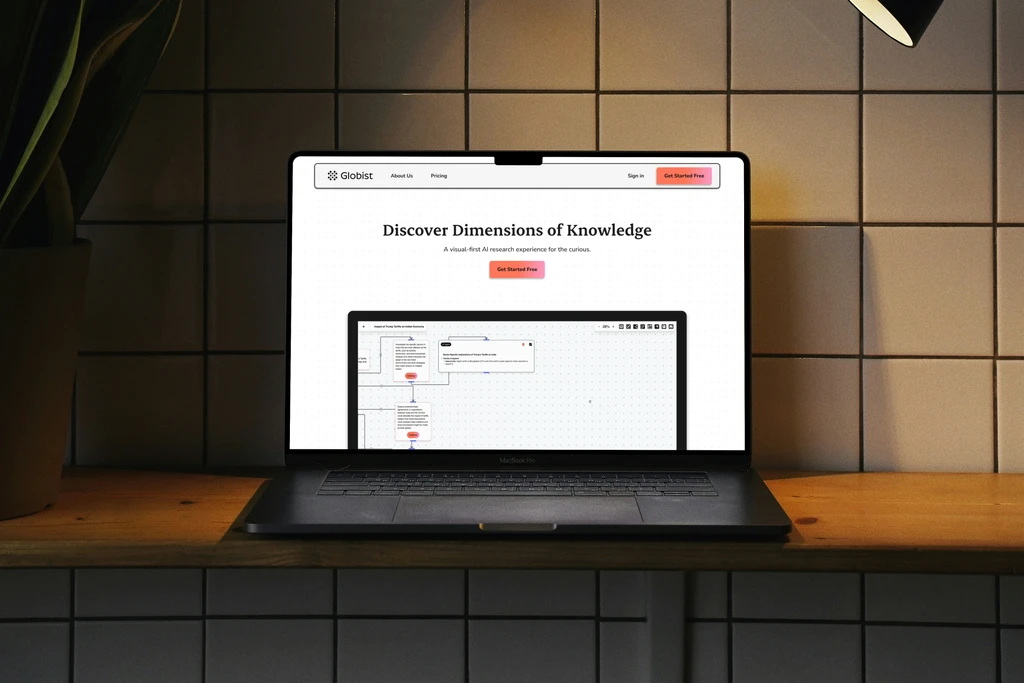
Landing Page UI: Designed a user-friendly landing page that communicated Globist’s value proposition clearly, smoothed onboarding, and set the right first impression for both researchers and potential investors.
Published Canvas: Created conceptual designs for Globist’s growth pillar. A tool that allowed users to share their Canvas’ with their peers. The design emphasized intuitiveness, shareability, and a sense of exploration.
Supporting Artifacts: Delivered brand guidelines, wireframes, and Figma designs to ensure handover and implementation would be seamless.
The iteration process was highly collaborative with the founder, with frequent checkpoints and reviews. To add an external validation layer, I informally tested flows and visuals with researcher friends, making sure the identity felt serious enough for adoption yet flexible enough for exploration.



Phase 5: Validation
Validation was built into every step, not just a final checkbox. The checkpoints included:
Stakeholder reviews at each major iteration, ensuring alignment with founder vision.
Surveys with researchers to test credibility, clarity of messaging, and usability of the landing page and Published Canvas.
The validation confirmed that Globist’s new direction addressed the core issues:
The identity was perceived as mature and trustworthy.
The UX flows were smoother and easier to navigate.
The product positioning was clearer and differentiated from competitors.
By embedding validation iteratively, we reduced the risk of misalignment and ensured both business and user perspectives were accounted for in the final output.
insights & impact
Client alignment: Globist’s team achieved clarity on their story and alignment on brand positioning, with a clear design + message foundation for launch readiness.
User validation: A usability and messaging survey with 6 target users revealed:
5/6 understood what Globist does.
6/6 perceived Globist as a credible tool.
4/6 found the experience smooth and intuitive.
5/6 expressed interest in sharing Globist with family and friends.
Concept adoption: Out of three proposed concepts, Unboxed Curiosity stood out immediately, aligning with the client’s values and vision.
Competitive distinction: While many competitors leaned on curiosity as a surface-level idea, our articulation of curiosity as exploration and evolution of knowledge differentiated Globist — relevant enough to resonate, novel enough to stand out.
Strategic impact: The chosen direction became the basis for Globist’s brand foundation, shaping not just their identity but also their future product roadmap and storytelling approach.

reflections & takeaways
Learning curve: This project immersed me in the context of AI-powered research, exposing me to the technical depth, methodologies, and nuances that researchers value. Understanding these details sharpened my perspective on the product’s ecosystem and helped me connect design decisions back to user expectations in a more grounded way.
Design philosophy: Marrying philosophical weight (curiosity, exploration) with digital-first identity reinforced that abstract concepts can thrive in modern design when executed with balance.
What I’d do differently: If I were to revisit this project, I would have co-designed the research canvas directly with target users. Their involvement could have added richer context, deeper validation, and an even stronger sense of ownership over the experience.
Biggest realization: This work reaffirmed for me that the most impactful branding angles are often not the loudest or most obvious ones. They exist just beneath the surface, waiting to be discovered — and when surfaced thoughtfully, they have the potential to transform how a brand is seen.
In sum, this project taught me how to bridge rigorous research and creative storytelling, and how to uncover brand narratives that are both strategically relevant and emotionally resonant.